






How to Choose 4th Grade Homeschool Curriculum
Fourth grade is an exciting stage of learning. Children are developing greater independence while building the academic skills they will rely on in the years ahead. The right homeschool curriculum should challenge your child academically, encourage curiosity and critical thinking, and fit your family’s homeschool goals and daily rhythm.
When choosing a 4th grade homeschool curriculum, start by considering what your child needs to learn, where they are academically, how they learn best, and how much time your family wants to devote to formal lessons. You’ll also want to consider factors such as teaching style and your family’s worldview.
In this guide, we’ll walk through what a fourth grader should learn, what to look for when choosing homeschool curriculum, and how much time you might expect to spend homeschooling each day. We’ll also explore Apologia’s 4th grade homeschool curriculum resources.
What Should a 4th Grader Learn?
Fourth grade is an important year for building independence and strengthening the foundational skills students will use throughout their education. A well-rounded 4th grade homeschool curriculum typically includes math, language arts, science, history or social studies, and Bible or worldview instruction, along with opportunities for reading, writing, creativity, physical activity, and other interests.
In math, fourth graders generally build fluency with multiplication and division while developing a deeper understanding of fractions, decimals, measurement, geometry, and multi-step problem-solving.
Science introduces students to increasingly complex concepts while encouraging them to observe, ask questions, conduct experiments, and understand how the world around them works.
Language arts typically focuses on reading comprehension, vocabulary, grammar, spelling, writing, and communicating ideas clearly. Students should have regular opportunities to read independently and respond to what they read.
The focus of 4th grade history and social studies would be having your children understand people, places, cultures, government, geography, and important events from the past.
For Bible or Worldview, fourth graders continue to develop a biblical worldview and learn to connect what they are studying with their faith.
The goal isn’t simply to check off a list of subjects. A good fourth grade homeschool curriculum should help your child grow academically while developing curiosity, critical thinking, confidence, and greater independence as a learner.
How to Choose the Right 4th Grade Homeschool Curriculum for Your Family
There isn’t one curriculum that is right for every fourth grader. The best choice depends on your child’s academic level, learning needs, interests, and your family’s homeschool philosophy and schedule.
As you compare curriculum options, consider these questions:
1. What is your child’s current academic level?
Your child doesn’t necessarily need to use fourth-grade curriculum in every subject. A child may be working at a fourth-grade level in reading but need additional support in math—or be ready for more advanced material in another subject.
Look for placement assessments or other tools that can help you determine where to begin.
2. How does your child learn best?
Consider whether your child responds best to:
-
Hands-on activities
-
Reading and narration
-
Visual instruction
-
Independent work
-
Experiments and demonstrations
-
Repetition and practice
-
Discussion and conversation
A curriculum that fits your child’s learning needs can make lessons more engaging and productive.
3. How much preparation do you want to do?
Think about how much time you realistically have for lesson preparation. Many families prefer an open-and-go curriculum with clear daily instructions, while others enjoy creating their own lessons and gathering supplemental resources.
4. How much independence is appropriate?
Fourth graders can often begin taking more responsibility for their schoolwork, although the amount of independence will vary from child to child.
Look for curriculum that gives your child opportunities to work independently while still providing the instruction and support they need.
5. Does the curriculum fit your family’s values?
Curriculum isn’t only about academic content. Make sure your materials consistently reflect a biblical worldview and help your child connect what they are learning to their faith.
6. Will you enjoy teaching it?
This is easy to overlook. You’ll be using the curriculum regularly, so consider the teacher’s guide, lesson format, amount of preparation, and overall approach. A curriculum should work for your family, not just look good on a curriculum comparison chart.
How Many Hours a Day Should a 4th Grader Homeschool?
For a fourth grader, a reasonable starting point is about 3–4 hours of focused academic work each day. However, the right amount of time will vary based on your child’s needs, learning pace, curriculum, and your family’s homeschool goals.
Homeschooling doesn’t need to replicate a traditional school day. In a classroom, much of the day can be spent on transitions, classroom management, waiting, and activities that aren’t directly related to your child’s individual learning. At home, one-on-one instruction and independent work can make learning more efficient.
A 3–4 hour homeschool day might include:
-
Math: 30–45 minutes
-
Language arts: 45–60 minutes
-
Science: 30–45 minutes
-
History or social studies: 30–45 minutes
-
Bible or worldview: 15–30 minutes
-
Independent reading, practice, or projects: 20–30 minutes
These don’t have to be completed in one continuous block, and you don’t necessarily need to teach every subject every day. Some families alternate subjects throughout the week, while others prefer a consistent daily routine.
It’s also important to remember that not all learning happens during formal lesson time. Reading for fun, conducting a science experiment, visiting a museum, exploring nature, working on a project, practicing an instrument, or discussing a history topic over lunch can all be meaningful parts of a homeschool education.
As your fourth grader grows, you may also find that some subjects require less direct teaching. A child who can complete an independent reading assignment or math practice without your help may need less one-on-one instructional time than a child who needs additional guidance.
Rather than focusing on whether you have reached a specific number of hours, look at the bigger picture: Is your child learning, making progress, developing confidence, and gaining greater independence? If the answer is yes, your homeschool day is doing what it needs to do.
The flexibility to adjust the pace is one of the advantages of homeschooling. Start with a manageable routine, observe how your child responds, and adjust your schedule as you learn what works best for your family.
Apologia’s 4th Grade Homeschool Curriculum
4th Grade Science: Exploring Creation with Earth Science
God created an amazing planet for us. From our seasons, weather, and atmosphere to the mountains, seas, and caves, to the minerals, biomes, and ecosystems, God not only designed a beautiful planet but one that was organized and so specifically designed to be habitable.
Genesis 1:6-10, 14 says,
And God said, “Let there be an expanse in the midst of the waters, and let it separate the waters from the waters.” And God made the expanse and separated the waters that were under the expanse from the waters that were above the expanse. And it was so. And God called the expanse Heaven. And there was evening and there was morning, the second day.
And God said, “Let the waters under the heavens be gathered together into one place, and let the dry land appear.” And it was so. God called the dry land Earth, and the waters that were gathered together he called Seas. And God saw that it was good.
And God said, “Let there be lights in the expanse of the heavens to separate the day from the night. And let them be for signs and for seasons, and for days and years,
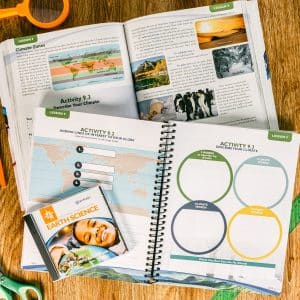 For fourth grade, consider going through Exploring Creation with Earth Science, written by Rachael Yunis. Some of the experiments in this book are fan favorites. Enjoy watching crystals form, understanding quick-cooling igneous rocks by eating ice cream, making putty, and spending the year creating and adding to a paper mache geosphere to map out the various spheres and biomes of the Earth.
📖 In Apologia’s Exploring Creation with Earth Science, your student will explore and learn about the observable universe, life in the habitable zone, spheres of the Earth, mapping our planet, the forces that make and shape the land and sea, climate and weather, cycles of life, and unique places on Earth as they reveal the marvel and might of our loving Creator.

4th Grade Math: Exploring Creation with Mathematics, Level 4
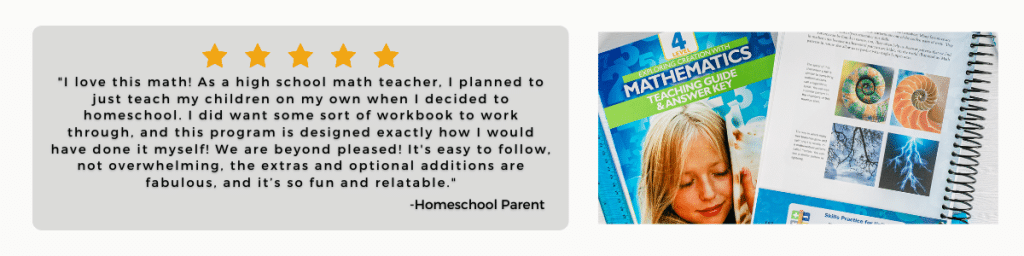
Don’t let your child develop an “I hate math!” attitude. Math doesn’t have to be tedious, boring, and a time full of tears. Exploring Creation with Mathematics, Level 4 is a great curriculum for any fourth-grader who enjoys hands-on activities, short lessons, and colorful pages that explain the concepts clearly and from a Biblical worldview.
Your child will not waste hours on practice problems but rather learn the concept and practice just enough to master it. Review is also built into the beginning of each new lesson.
Apologia’s elementar y math curriculum by Kathryn Gomes offers your student a strong foundation in mathematics using a proven method: the Concrete, Pictorial, Abstract progression.
📖 Exploring Creation with Mathematics, Level 4, is a hands-on, interactive math curriculum designed to encourage your child to explore math on a deeper level. Students will learn more about symmetrical patterns that open their eyes to the beauty, order, and truth of Creation. Higher-level multiplication, division, geometry, measurements, fractions, and decimals are some of the topics covered in this course. Each unit takes students on a journey of discoveries that make common, age-appropriate connections, building the strong foundations that are crucial for success in higher-level mathematics.
Find the Right 4th Grade Homeschool Curriculum for Your Family
Choosing homeschool curriculum doesn’t have to mean finding the one “perfect” program. It means finding resources that fit your child, your family, and your homeschool goals. Start by considering the skills and subjects your fourth grader needs to develop. Then think about your child’s current academic level, learning style, interests, and growing independence. Finally, consider your own teaching style, the amount of time you have available, and the kind of learning environment you want to create at home.
Choose the resources that help your fourth grader learn, grow, and discover the wonder of God’s creation—and enjoy the journey together.