




Math Without the Meltdown: Exploring Creation with Mathematics
If you’ve ever sat across the kitchen table from a frustrated kiddo who’s convinced they’re “just not a math person,” you are not alone. Not even a little bit. And if you’re the mom who secretly agrees with them because math wasn’t exactly your strong suit either—well, this one’s for you.
She’s One of Us
Here’s something that might surprise you: Kathryn Games, author of Exploring Creation with Mathematics, was homeschooled herself, and by her own admission (shared with a laugh and her mom’s full agreement), math wasn’t their strong suit. She didn’t come from an elite math-gifted household. She went to college, earned her master’s in education, became a high school math teacher, and then started asking a really important question: How can we do this better for homeschool kids?
That question led to Exploring Creation with Mathematics, a curriculum built from the ground up with homeschool families in mind—not adapted from a classroom model, but designed specifically for the way we learn and teach at home.
The Philosophy Behind the Program (And Why It Matters)
You’ve probably heard the terms “mastery” and “spiral” thrown around when researching math curricula. Mastery means focusing on one concept at a time until it clicks. Spiral means weaving topics together with lots of review. Both have their fans.
Kathryn’s curriculum is a hybrid—and she makes a compelling case for why. Kids learn new concepts in focused, dedicated chapters (hello, mastery), but there’s also a short daily “skills practice” block that revisits previously learned material. That consistent review is what helps concepts stick long-term. It’s the kind of approach that keeps multiplication facts from disappearing over summer break.
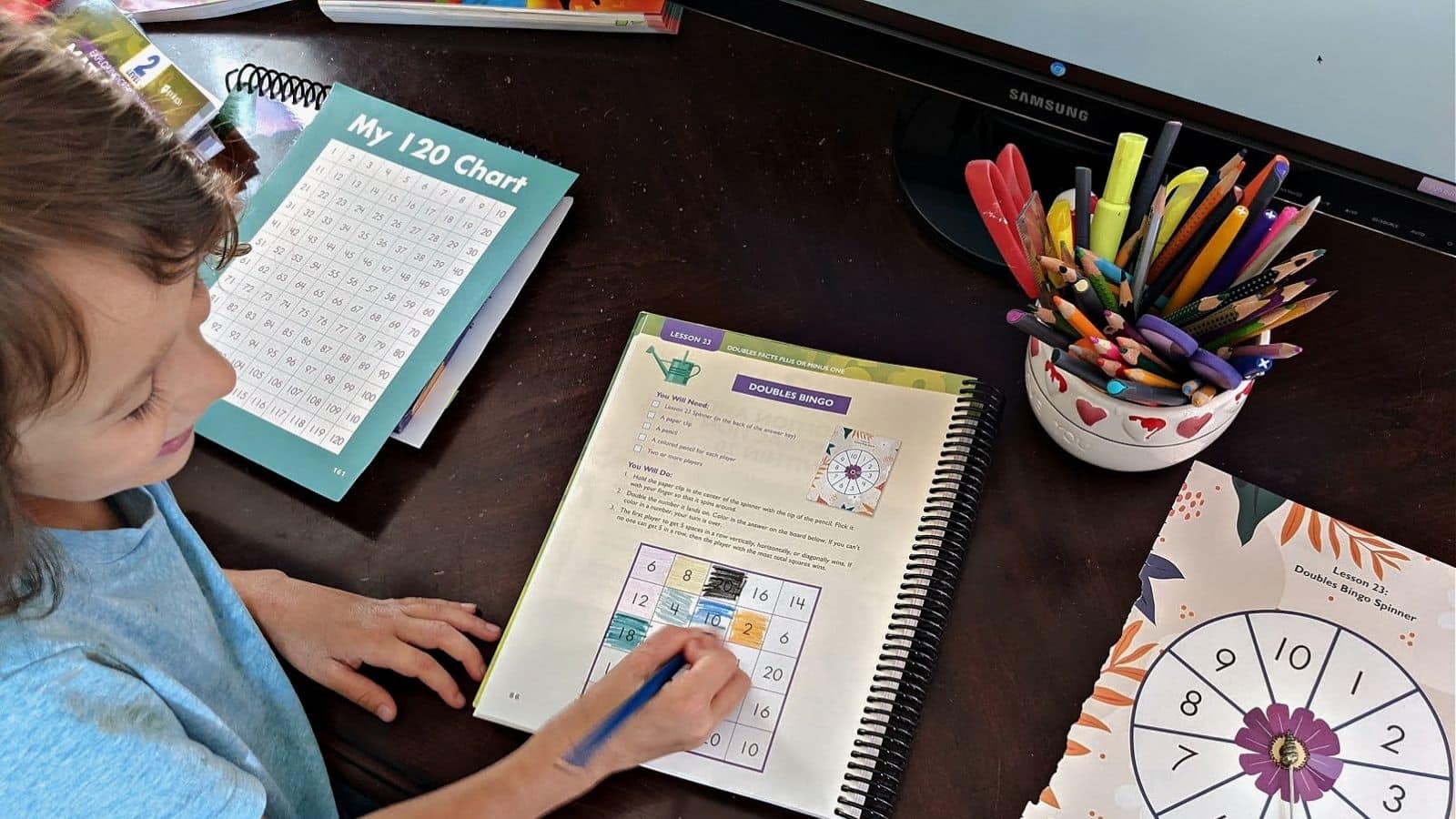
The other cornerstone of the curriculum is what researchers call the concrete-pictorial-abstract progression. This is the idea that kids need to touch and manipulate things first (think beans, play money, or whatever’s in your junk drawer), then see pictures of the concept, and only then work with abstract numbers and symbols. Almost every lesson in this curriculum begins with a hands-on activity. Kathryn shared that when she taught her own daughter long division, they were literally splitting pretend money into piles on the floor—real learning in action.
Confidence Is Everything
One of Kathryn’s most refreshing perspectives is on the role of confidence in math success. She’s seen it from both sides—students who thrive because they believe they can, and students who spiral downward because they’ve decided they can’t.
Her advice? Sometimes you need to change the context entirely. She told a story about her own child who struggled with multi-digit addition — until the family got obsessed with a card game called Flip Seven. Suddenly, that same child was happily adding three-digit numbers to keep score—no hesitation and no dread. The math was the same, but the attitude was completely different.
If your child is hitting a wall, Kathryn suggests taking a week off from the curriculum and just playing math games. Fill in a specific gap (multiplication facts are the big ones she hears about almost daily), or simply acknowledge that math is hard sometimes, and say, “I struggled at times, too.”
You Don’t Have to Be Good at Math to Teach It
Being good at math and being good at teaching math are two completely different skill sets.
Kathryn was clear—parents don’t need to be math experts to shepherd their kids through this curriculum. The teaching guide includes notes to the parent on every single lesson. She told her editor she wanted it to be usable by a sleep-deprived mom who just needed to open it and go.
Your job as a homeschool parent is less “expert mathematician” and more “encouraging facilitator.” And that? We can all do.
Building Independence (Without Throwing Them in the Deep End)
As kids get older, math is one of those subjects that can shift toward independent study, but Kathryn encourages a gradual, scaffolded approach. In late elementary, she suggests sitting nearby without hovering. In middle school, stay closely engaged early in the year, then slowly pull back as your student finds their footing. By high school, the goal isn’t independence in isolation, but teaching kids how to get help when they need it, whether that’s through a video, a co-op friend, or a tutor.
Consistency Is the Secret Sauce
If there’s one practical takeaway, it’s to do a little math every single day. Skill-based subjects like math, reading, and foreign language are built through daily repetition. Our brains just aren’t wired to cram a week’s worth of math into one afternoon session.
If math is a struggle in your house, try doing it first thing in the morning when brains are fresh. And if you want bonus points? One Instagram mom Kathryn follows does “tea time with mathematics.” Those kids are going to remember their multiplication facts and have a cozy memory attached to them.
What’s New: The Skills Practice Book
Apologia just launched a Skills Practice Book for Exploring Creation with Mathematics, Levels Five and Six. This is essentially the spiraling review portion of the curriculum pulled into its own standalone book, with tear-out pages, coloring activities, games, and systematically scaffolded practice. It’s perfect for tossing in a bag for waiting rooms, appointments, or library trips.
A Note for the Moms Who Are Struggling Right Now
Kathryn said that when families in her co-op are having a math meltdown, she asks one question.
“Did you feel called to homeschool?” When they say yes, she says, “Then God called you to this part too, and He’ll meet you here.”
Whether you’re navigating a confidence crisis, wondering if you need to switch curriculum, or just trying to figure out how to make math feel less like a battle, that’s a good thought to hold onto.