



How to Choose 11th Grade Homeschool Curriculum
Can you believe it, Mom? Your baby is just two years away from graduation. As you process the joy, excitement, fear, and probably some grief (we know you’re feeling all the feelings about this), let’s explore how to make the most of these last two years and set your student up for college and career success.
You likely have many questions. What subjects should your student take this year? What records do you need? What should your upperclassman’s school day look like? How do you prepare for a homeschooler’s graduation?
11th grade homeschool curriculum requirements
An 11th grade homeschool curriculum should provide a strong academic foundation, prepare students for their chosen post-high-school path, and meet any applicable state homeschooling requirements. Grade 11 is also an important year for college preparation, transcript development, and exploring career interests.
What subjects should an 11th grader study?
A typical 11th grade homeschool curriculum includes:
-
English: Literature, composition, grammar, research papers, and critical reading.
-
Mathematics: Algebra II, geometry review, precalculus, statistics, or another appropriate course based on the student’s math progression.
-
Science: Chemistry, physics, environmental science, or another lab-based science.
-
Social Studies: U.S. history, government, economics, or another history course.
-
Electives: Art, computer science, business, music, personal finance, foreign language, or career-focused courses.
-
Physical Education and/or Health
Homeschooling an 11th grader for college
Homeschooling an 11th grader for college means balancing a rigorous high school curriculum with college admissions preparation. Junior year is an ideal time to research colleges, review admission requirements, build a transcript, and identify any academic gaps before senior year.
Which courses should a college-bound homeschooler take?
While every state, college, and career path has different requirements, a general outline for a strong college-preparatory plan typically includes:
-
Four years of English by graduation.
-
Mathematics through at least Algebra II, with precalculus or calculus for many math-intensive programs.
-
Three to four years of laboratory science, depending on the intended major and college.
-
Three to four years of social studies or history.
-
Two or more years of a foreign language, ideally continuing the same language.
-
Electives related to the student’s interests, intended major, or career goals.
What should parents prioritize during 11th grade?
Review the transcript
Check completed credits, grades, course rigor, and any missing prerequisites.
Research colleges
Compare admission requirements, application deadlines, tuition, and available programs.
Plan standardized testing
Check whether prospective colleges require or recommend SAT or ACT scores, and prepare accordingly.
Develop extracurricular activities
Encourage meaningful involvement in employment, volunteering, clubs, research, creative projects, or community activities.
Document coursework
Keep a detailed transcript, course descriptions, syllabi, and records of outside classes or dual enrollment.
Recommendation letters
Decide on and arrange for instructors, tutors, coaches, or mentors who know the student’s work to provide recommendations when appropriate.
Create a college-preparation checklist during the first half of 11th grade. This gives your student time to address missing prerequisites and prepare for applications well before senior-year deadlines.
What records should homeschool parents keep?
Maintain a permanent high school record that includes:
-
A transcript listing courses taken in grades 9–12
-
Final grades and credits earned for each course
-
A grading scale and credit calculation method
-
Course descriptions, textbooks, syllabi, and major projects
-
Standardized test scores or assessment records
-
A graduation date and a copy of the diploma
-
Any required homeschool registration and compliance documentation
How to create an 11th grade homeschool schedule
Creating an 11th grade homeschool schedule starts with identifying required courses, setting weekly learning goals, and organizing lessons around your student’s learning style and family commitments. A consistent routine helps students stay on track while leaving time for college preparation, extracurricular activities, and independent study.
How many hours should an 11th grader homeschool each day?
Many families plan for approximately four to six hours of focused academic work per day, although the time needed depends on course difficulty, teaching methods, independent assignments, and outside classes.
Five steps to build an effective schedule
-
List required courses. Prioritize core subjects and any remaining graduation credits.
-
Set weekly goals. Decide which lessons, chapters, assignments, and projects to complete each week.
-
Schedule demanding or challenging subjects when your student is most alert and focused.
-
Build in flexibility. Reserve time for lab work, field trips, appointments, extracurricular activities, and unfinished assignments.
-
Review progress weekly. Adjust the following week’s schedule based on completed work and areas that need more attention.
Should homeschool schedules follow a traditional school day?
Not necessarily. One advantage of homeschooling is the ability to tailor learning hours to the student’s needs. Some students prefer a traditional Monday-through-Friday routine, while others work better with longer study blocks, a four-day academic week, or a mix of independent learning and scheduled instruction.
Keep a weekly planner that tracks subjects, assignments, grades, and instructional time. This helps you stay organized and makes it easier to maintain the academic records needed for graduation and college applications.
Homeschool high school graduation requirements
Homeschool high school graduation requirements depend on your state, the type of homeschool program you operate, and the student’s plans after graduation. Unlike students attending public high schools, homeschool students may not be subject to the same state-issued diploma requirements. Families should verify their legal obligations and establish an academic plan that prepares the student for their next step.
Does a homeschooled student receive a high school diploma?
In homeschool settings, the parent determines when the student has met the program’s graduation requirements and issues a diploma. Davis Carman, CEO of Apologia, recommends marking the moment with symbols like ordering a cap and gown for your student to wear when you hand them their diploma. Read this blog for more ways to make your student’s homeschool graduation special.
Apologia 11th Grade Homeschool Curriculum
Apologia offers math and science courses through high school graduation. Based on our recommended curriculum path, your 11th-grade student would take either Exploring Creation with Marine Biology or Exploring Creation with Physics, Algebra II, and British Literature: Shakespeare. Your student could also take electives like Exploring Creation with Forensics and Church History for a well-rounded year.
Apologia Science (Choose One)
Marine Biology
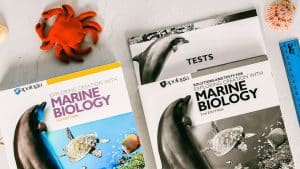 Apologia’s Marine Biology is one of the few homeschool science courses that include an entire education on ecology. It gives students self-directed learning tools to help them thrive and master key science concepts.
God designed the earth’s intricate ecosystem for his glory and the needs of those He created, and it is crucial for Christians in our day to accurately understand the ocean’s ecosystems and resources and how we can best steward them.
This course is offered through a textbook course set, or through our Self-Paced program.
Exploring Creation with Physics
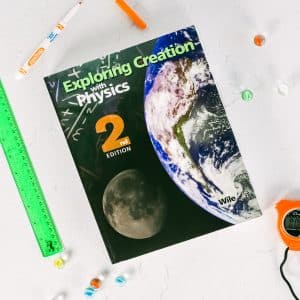 Because physics is an attempt to explain everything observed in nature, this text is an overview of the advances made over the last three thousand years! When your student completes Apologia’s physics course, they will be able to relate velocity, acceleration, time, and displacement; use mathematical equations for one-dimensional motion; understand and apply Newton’s Laws; and see the strong connection between math and science.
Exploring Creation with Physics, 2nd Edition, is written in a conversational format with the author talking directly to your student. We guide them through key learning strategies, such as thinking critically about what they are learning, identifying important parts of the information presented, taking meaningful notes, and completing experiments.
This course is offered through a textbook course set or Apologia Live Classes.
Science Elective: Exploring Creation with Forensics

Exploring Creation with Forensics can be used for high school science credit, particularly for students who need an elective science course. It includes in-depth study materials, hands-on experiments, and critical thinking exercises to meet academic requirements.
Are you ready to dive into the intriguing world of forensic science from a Christian perspective? Exploring Creation with Forensics by Apologia is a captivating high school science curriculum that takes students through crime scene investigations, fingerprint analysis, DNA evidence, and more—all while reinforcing a Biblical worldview.
Designed for students in grades 11-12, this engaging course includes hands-on activities, expert insights, and real-world forensic techniques. Whether your student is passionate about solving mysteries or looking to enter law enforcement or forensic science, Exploring Creation with Forensics provides a comprehensive, faith-based approach to one of today’s most exciting fields.
Discover how forensic science works in real life and develop critical thinking skills with Apologia’s trusted curriculum.
Mathematics: Algebra II
 In Apologia’s Live Online Algebra II class, students will learn concepts such as linear, quadratic, polynomial, radical, and rational functions, exponential and logarithmic functions, and probability and statistics. This class will solidify all of the concepts learned in Algebra 1 and prepare students for higher-level math.
Students will also learn how mathematics is used to serve others and glorify our Creator through real-world applications.
English: British Literature: Shakespeare
 Apologia’s Live British Literature: Shakespeare class explores six classic plays from Shakespeare’s body of work. Students will discover that Shakespeare’s greatness lies not only in his brilliant, beautiful use of language but also in his profound ideas, often shaped by his reading of recent English translations of the Bible. His themes relate to students’ longings, hopes, fears, struggles, and successes, and studying his plays helps them connect their life experiences with the truth of God’s word.
Elective: Church History
 Apologia’s Live Church History class is not an apologetics class. Instead of debating ideas, students explore how Christian faith was lived, challenged, and preserved through real historical events from Pentecost to the present.
By examining persecution, reform, revival, and the Church’s relationship with culture and government, students develop discernment, historical understanding, and a deeper confidence in their faith. This course helps students understand why the Church looks the way it does today and why that history still matters.
Make the Most of 11th Grade: Preparing for the Next Chapter
Your student’s junior year is an exciting milestone in your homeschool journey. With just two years until graduation, now is the time to strengthen academic foundations, explore future interests, prepare for college or career opportunities, and begin planning for that special graduation day. While there may be plenty to accomplish, remember that you don’t have to have every detail figured out today.
Focus on creating a balanced homeschool experience that challenges your student academically while giving them opportunities to grow in independence, discover their God-given gifts, and deepen their relationship with the Lord. Keep accurate academic records, review graduation requirements, and make time for meaningful conversations about what comes next.
Most importantly, don’t let the busyness of junior year cause you to miss the moments that make homeschooling so special. Celebrate your student’s accomplishments, encourage their developing independence, and enjoy learning alongside them.
At Apologia, we’re here to help you make these final two years of high school meaningful and academically enriching. With Christ-centered homeschool curriculum, engaging science and math courses, and opportunities to learn alongside other homeschool students, you can confidently prepare your student for the road ahead.
Before you know it, you’ll be handing your student that diploma. Make these last two years count!