





Be Encouraged: Of All the Educational Options, Homeschooling Is the Ideal
Welcome to a new conversation about home education—one that unfolds slowly, thoughtfully, and with purpose. Over the next four months, we’ll continue to explore homeschooling by asking good questions and leaning into meaningful answers. This is part two of a five-part series following the why behind home education as much as the how; the heart, the habits, the hope—and yes, the hard parts too.
Homeschooling isn’t just an academic choice; it’s a family decision that shapes your days, relationships, and future. In this series, we’ll talk about the who, what, when, where, why, and how of educating at home—an honest conversation with practical advice and counsel. Our goal is to affirm and encourage you in the decision to homeschool, challenge and inspire you to take it to new heights, and celebrate everything that you get to experience along the way in this adventure of a lifetime—one month at a time.
Whether you’re brand new to homeschooling or years into the journey, this series is an invitation to pause, reflect, catch your breath, take it all in, and celebrate the journey. Because home education isn’t just something you do or experience—it’s a lifestyle.
Be Encouraged: Of All the Educational Options, Homeschooling Is the Ideal
Be encouraged. I want to start right there, because encouragement is what so many homeschooling parents need—especially in the early years and on the hard days. You have stepped into the adventure of a lifetime. You have chosen a path that is demanding, countercultural, and deeply meaningful. But know this: you are not alone.
There are already millions of families educating their children at home, and the community continues to grow every single year. New families are joining the movement daily, discovering what many of us have already learned: homeschooling is not only possible, it is powerful. There is more curriculum available today than ever before—and better curriculum, too. Online options abound. Co-ops are thriving. Support networks are strong. You are standing on the shoulders of many who have gone before you, blazing trails, making mistakes, learning lessons, and passing along wisdom. You can do this.
Family education changes everything. It changes your marriage. It changes your parenting. And, obviously, it changes how your children are educated. But it does more than that; it reshapes priorities. It slows life down just enough to ask the most important questions. It reorders the home around relationships instead of schedules and around discipleship instead of bus routes.
This is not merely an educational choice. It is a movement. I would even say it is a spiritual awakening. We are watching Malachi 4:6 come to life before our eyes: “He will turn the hearts of the fathers to their children, and the hearts of the children to their fathers.” Dads are engaging, and moms are persevering. Children are being known, loved, and discipled in the context God designed—the family.
So once again, be encouraged.
Answering the Critics
Critics of homeschooling are quick to point out what they believe are weaknesses in this educational model. You’ve probably heard the list:
- small class sizes
- paltry budgets
- modest facilities
- little socialization
- less standardized testing
- No teacher certification.
Let’s briefly address each one.
Small Class Size
We raised seven children. People used to look at us with wide eyes and ask, “How in the world do you teach that many kids?” I always found that question interesting. Seven students with one teacher is a ratio of seven-to-one. If you include two parents, it drops to 3.5-to-one. Compare that to the typical classroom of 15 to 25 students per teacher. Suddenly, the so-called weakness looks like a tremendous advantage.
Paltry Budgets
A 2024 study found that homeschooling families spend an average of about $1,295 per student per year during elementary school and $1,636 during junior high and high school. Compare that to the $15,000–$20,000 per student of taxpayer money that states spent in public schools, and often the same amount or more for private schools. Homeschooling wins this round, too. More money does not automatically mean a better education, especially when the most important investments are time, attention, and love.
Modest Facilities
Homeschools don’t usually have gyms, cafeterias, or science labs. But they do have the great outdoors, a well-stocked pantry, and a kitchen table that can transform into a classroom, art studio, laboratory, or conference room. No hall passes, long lines for the restroom, or daily commute. I’ll give homeschooling another point here.
Little Socialization with Peers
According to studies by the National Center for Education Statistics, the number one reason families chose to homeschool in the early 2000s was concern about negative social environments. And that was long before many of today’s cultural battles dominated the headlines. Family has always been the safest and healthiest context for children. Even in March of 2020, when fears of COVID-19 swept the nation, the government sent children to the place it deemed safest: home.
Less Standardized Testing
Standardized tests have their place, but they have real limits. They cannot measure wisdom, character, creativity, or virtue. What if your student is a gifted artist, musician, philosopher, athlete, or counselor? Remember this: squirrels always fail swimming tests, and ducks always fail tree-climbing tests. Homeschooling allows parents to focus on teaching children to love reading, love learning, and love God, family, and neighbor—the things that matter most.
No Teacher Certification
You may not have a teaching certificate, but you are your child’s parent. You love them more, know them better, and care more deeply about their future than anyone else. You are willing to make sacrifices that no hired professional ever could. I call this lack of certification a desirable disadvantage.
And here’s something else: as a homeschooling parent, you can hug your students. And you should—often.
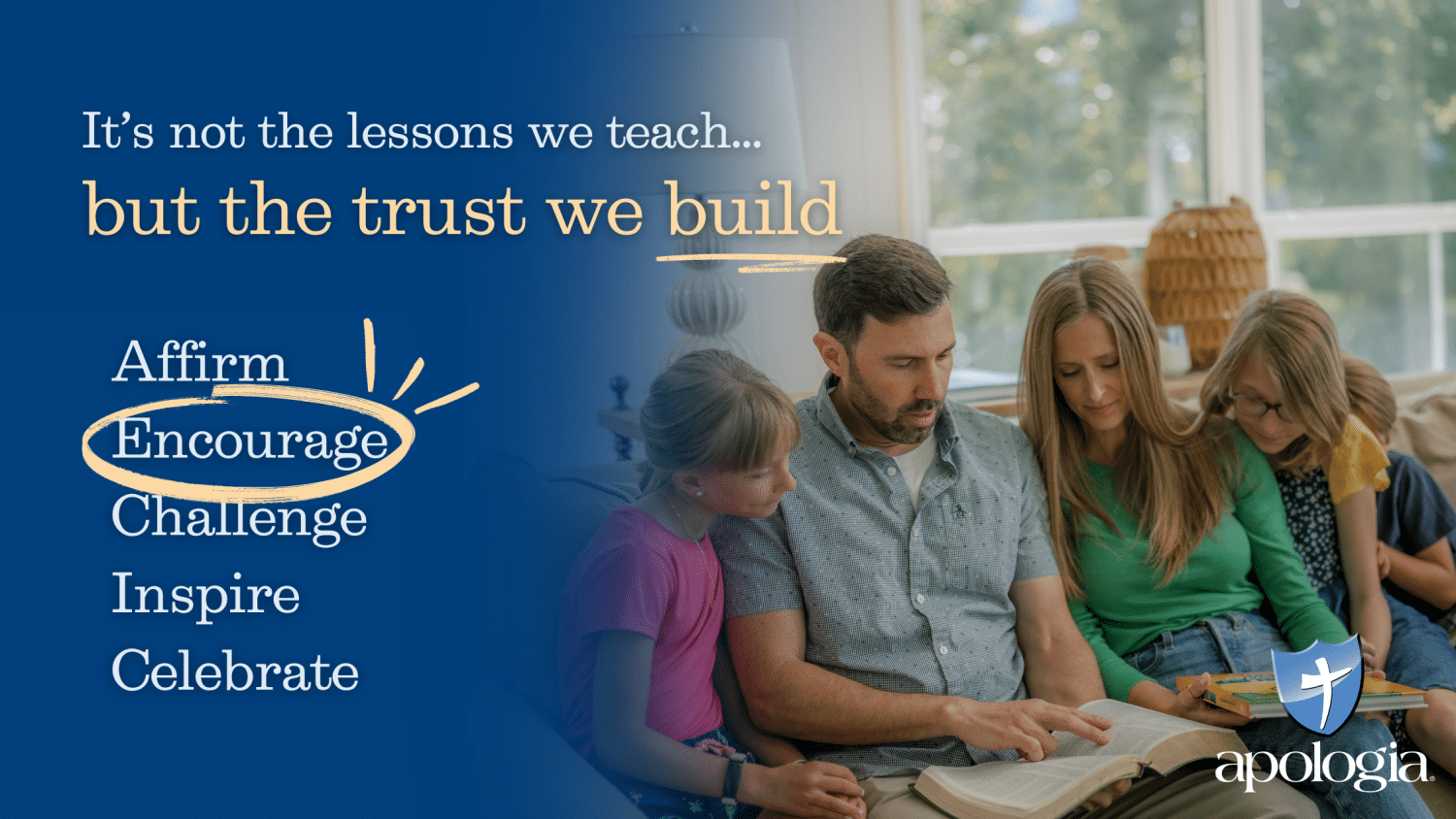
In the end, it’s not the lessons we teach, but the trust we build and the love we share—heart-to-heart, eye-to-eye, hand-to-hand—that fills our lives with meaning.
Rethinking Curriculum
Let me ask you a question. How often have you heard this conversation?
Adult: “How’s school going? What’s your favorite subject?”
Teen: “I dunno. I hate school.”
We’ve all heard it. But should we accept it as normal? I don’t think we should. I think we should want something better.
Is it possible to instill a genuine love of learning? I believe it is. But first, we need to rethink the curriculum.
Most people define curriculum as a list of subjects: math, science, history, and language arts. Some add Bible, philosophy, music, Latin, or physical education. Others emphasize life skills or technical trades. All of these can be good and valuable.
But here’s a better definition: curriculum is a course—a path. When you homeschool, you are choosing the journey your child will take, with a destination in mind. That raises an important question: what kind of person do you want your child to become?
Would you prefer a graduate with skills, knowledge, or wisdom? Where does virtue fit in? Too often, no one asks what education is for. Students jump through hoops. Educators market products. And somewhere along the way, the pursuit of truth, goodness, and beauty is lost.
C. S. Lewis warned us about this in “The Abolition of Man,” especially in the essay Men Without Chests. Knowledge without virtue is dangerous. Neil Postman put it bluntly:
Modern secular education is failing…because it has no moral, social, or intellectual center. The curriculum is not, in fact, a “course of study” at all but a meaningless hodgepodge of subjects. It does not even put forth a clear vision of what constitutes an educated person, unless it is a person who possesses…marketable skills.
The Most Important Lessons
In a keynote address I gave in Arizona in July 2024, I encouraged families to persevere. If you finish the course—if you graduate your children from your family homeschool—they will hold the most valuable diploma on the planet.
So what should be at the heart of your curriculum? Here’s my list of the top five lessons every graduate needs:
- Love God with all their being.
- Love their neighbor as themselves.
- Love reading.
- Love learning.
- Know Jesus Christ.
Jesus said the greatest commandment is to love God, and the second is like it—to love your neighbor as yourself. (Matthew 22:36-40)No institution can teach these as effectively as parents who live them out daily—when you rise up, lie down, sit at the table, and walk along the way (Deuteronomy 6:7). A love of reading often takes patience—not every child reads at five years old. (The average age is closer to eight, plus or minus three years.) So read lots of good books together. When children are ready, they take off—and many become lifelong readers. A love of reading fuels a love of learning, and a love of learning produces lifelong students of God’s creation. And finally, knowing Jesus changes everything. Peter tells us that God’s divine power gives us everything we need for life and godliness through knowing Christ (2 Peter 1:3). Do we really believe that? Peter, John, and Paul had different educational backgrounds, but they shared one thing in common: they knew Jesus, and that made all the difference. You see, their knowledge of Jesus and resulting boldness was clear to others and simply astonished the religious rulers and elders of the day (Acts 4:13).
The Adventure of a Lifetime
So what path are you paving? What course are you charting? Will your graduates merely have marketable skills, or will they be wise, virtuous, and grounded in truth?
Home education truly is the adventure of a lifetime. Don’t miss it.
Go hug your child, read a book together, and keep building that relationship that will last forever.
And above all—be encouraged.