






How to Choose 6th Grade Homeschool Curriculum
Choosing a 6th-grade homeschool curriculum is an exciting step as your child moves into the middle school years. At this age, students are ready to build on the skills they developed in elementary school while taking on more challenging concepts, developing greater independence, and discovering how different subjects connect to the world around them.
But what should a 6th grader learn in homeschool? How do you choose the right curriculum for your child? And how much time should you plan to spend on lessons each day?
While every homeschool looks a little different, most 6th graders study core subjects such as math, language arts, science, and history or social studies, along with electives and other subjects that fit their family’s goals. The right curriculum should meet your child at their current level while giving them opportunities to grow academically, think critically, and develop a lifelong love of learning.
What should a 6th grader learn in homeschool?
A 6th grader should generally build on the foundational skills learned in elementary school while beginning to work more independently and think at a middle-school level. The exact curriculum will vary depending on your state, your child’s abilities, and your homeschooling approach, but most families cover several core areas.
Language arts should include reading comprehension, vocabulary, grammar, spelling, writing, and exposure to different types of literature and nonfiction. Sixth grade is also a good time to put more emphasis on organizing ideas, writing paragraphs and essays, researching topics, and supporting ideas with evidence.
Math typically moves beyond basic arithmetic into more advanced fractions, decimals, ratios, percentages, expressions, equations, geometry, statistics, and problem-solving. The goal isn’t simply to complete increasingly difficult calculations but to develop mathematical reasoning and apply concepts to real-world problems.
Science usually introduces students to more formal scientific investigation and concepts in areas such as life science, physical science, earth science, ecosystems, energy, matter, and the scientific method.
History and social studies may include ancient civilizations, geography, government, economics, U.S. history, world history, or civics, depending on the curriculum and state.
Families may also include physical education, health, art, music, foreign language, computer science, technology, and electives.
The most important thing is not to feel like you have to recreate a traditional classroom at home. A good sixth-grade homeschool program should give your child opportunities to read deeply, write clearly, solve problems, conduct hands-on investigations, ask questions, and gradually become a more independent learner.
How do I know which homeschool curriculum is right for my child?
There isn’t one homeschool curriculum that is right for every sixth grader. The best choice is the one that fits your child’s current academic level, learning needs, interests, and your family’s homeschool style.
Start by looking at what your child already knows. A curriculum labeled “6th grade” isn’t necessarily going to be at the right level in every subject. Your child might need sixth-grade math, fifth-grade writing, and seventh-grade science.
Then consider how your child learns best. Some students thrive with textbooks and worksheets, while others learn better through videos, projects, experiments, discussion, or hands-on activities. Also consider how much independent work your child can realistically handle.
It’s equally important to consider you as the parent. Ask yourself:
- Do I want a teacher-led program or something my child can do independently?
- Do I want to plan lessons myself or have everything scheduled for me?
- Does the curriculum match my family’s values?
How many hours a day should a 6th grader homeschool?
A good starting point for a 6th grader is about 3–5 hours of focused learning per day. This does not mean your child needs to sit at a desk for five straight hours. Homeschooling allows you to spread lessons throughout the day and include breaks, outdoor time, independent reading, hands-on projects, and other activities.
A typical day might look something like:
- Math: 45–60 minutes
- Language arts/reading: 60–75 minutes
- Science: 30–45 minutes
- History/social studies: 30–45 minutes
- Elective, project, or independent work: 30–45 minutes
That puts the structured portion of the day around 3–5 hours, depending on your child’s pace and how much independent work is included.
Some days will naturally be shorter and others longer. A science experiment, field trip, writing assignment, or challenging math lesson may take more time than expected, while a child who quickly masters a concept may finish sooner.
The goal isn’t to recreate a traditional 7-hour school day at home. Focus on progress and mastery rather than watching the clock. Your child’s age, learning style, curriculum, and state requirements should all factor into your schedule.
And if you’re just getting started, 3–4 hours is a reasonable place to begin, then adjust based on how your child responds to the workload.
Apologia’s recommended 6th grade curriculum path provides a starting point for planning the year. Students can explore chemistry and physics through a biblical worldview, strengthen their math skills with a mastery-based approach—all while building a foundation for future learning.
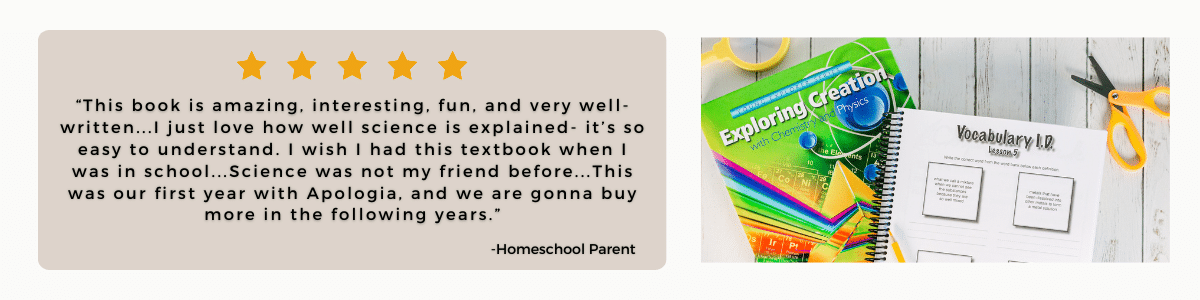
Apologia’s 6th Grade Science: Exploring Creation with Chemistry & Physics
Our Young Explorer Series, written by Jeannie Fulbright, was designed to be used in any order, which makes it great for use in families with children of multiple ages. However, a popular choice, and the order of our recommended curriculum path follows the order of Creation.
For sixth grade, consider going through Exploring Creation with Chemistry & Physics. By providing your student(s) with a strong foundation of the basics of these more complex concepts early on, they will be much more prepared to take on the more rigorous middle and high school science courses.
📖 Apologia’s Exploring Creation with Chemistry & Physics takes complex and abstract concepts and makes them approachable for curious young minds. Your student will better understand the fascinating world of chemistry and physics and the Master Designer who created it all through exploring the basic building blocks of creation, atoms and molecules, simple chemicals, the laws of motion, energy in its many forms, and concepts of electricity and magnetism.
Apologia’s 6th Grade Math: Exploring Creation with Mathematics, Level 6
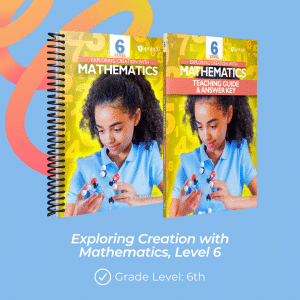 Have you ever thought about the fact that God created math? He did! So teach your children to see God through their math study with Apologia’s Exploring Creation with Mathematics, Level 6. This curriculum also offers your family lots of fun, hands-on activities while using a mastery approach.
Each of our math levels is designed to align with traditional grade levels, so level 6 is typically the best fit for a rising 6th grader. However, we always recommend using our Math Placement Test, especially if switching from a different curriculum.
This curriculum, by Kathryn Gomes, will give your student a strong foundation in mathematics using a proven method: the Concrete, Pictorial, Abstract progression.
📖 In Exploring Creation with Mathematics, Level 6, students will learn about fractions and ratios, rates and probability, and negative numbers. They’ll also receive an introduction to algebra to prepare them for higher-level math courses.
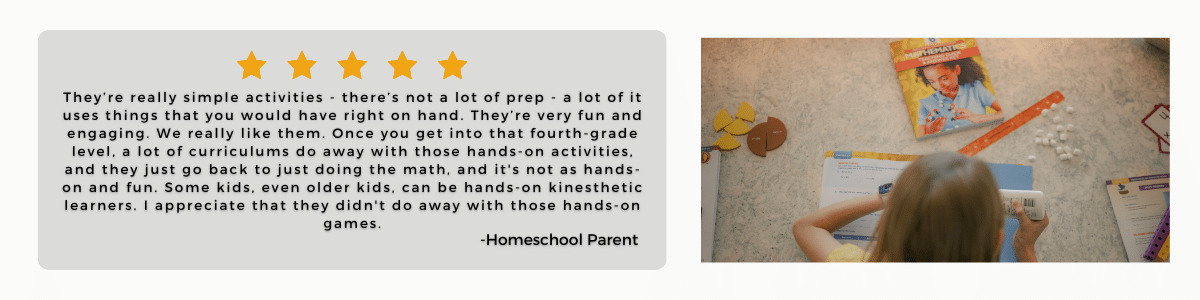
Units are presented along with fun, hands-on, interactive activities to help students make connections between the information they are learning and the real world so they can see the important role math plays in everyday life.
Sixth grade is an important transition year. Your child is beginning to encounter more advanced academic concepts while also developing the independence and critical-thinking skills they’ll need for the middle and high school years.
As you choose your 6th grade homeschool curriculum, consider your child’s current academic level, learning style, interests, and areas where they may need additional support. Look for curriculum that provides enough structure to keep your family on track while still giving you the flexibility that makes homeschooling unique.
Whether you’re continuing your homeschool journey or preparing to homeschool a middle schooler for the first time, remember that you don’t have to have every detail figured out before you begin. Start with your child’s needs, choose resources that fit your family, and adjust your approach as you learn what works best.