






How to Choose 7th Grade Homeschool Curriculum
Choosing a homeschool curriculum for 7th grade is an exciting milestone. Your child is moving deeper into the middle school years, developing greater independence, and building the academic skills that will prepare them for high school. As a homeschool parent, you have the opportunity to choose resources that meet your student’s needs while keeping your family’s educational goals and Christian values at the center of learning.
A 7th-grade homeschool curriculum should help your student strengthen foundational skills, explore new ideas, develop critical thinking, and grow in their understanding of God’s Word. You’ll also want to consider your child’s learning style, academic readiness, and how much structure or flexibility your family needs.
At Apologia, we believe homeschool curriculum should do more than cover academic subjects. It should encourage students to become thoughtful learners who understand the world around them through a biblical worldview. Our suggested 7th-grade curriculum path includes science, mathematics, and literature, with resources designed to support your student’s transition to more advanced learning.
In this guide, we’ll explore Apologia’s recommended seventh-grade curriculum, discuss how to choose the right resources for your child, and answer common questions about homeschool subjects, schedules, and preparing for high school.
What is the best homeschool curriculum for 7th grade?
The best homeschool curriculum for 7th grade is one that meets your student’s academic needs, fits your family’s teaching style, and supports your educational goals. Look for a program that covers core subjects thoroughly, encourages critical thinking, and gives your student opportunities to develop greater independence.
Choose resources that incorporate a biblical worldview. Apologia’s suggested 7th-grade curriculum path includes Exploring Creation with General Science, Fundamentals of Math, and self-paced literature unit studies that help students explore science, strengthen math foundations, and analyze meaningful themes in literature through a biblical lens.
Before choosing a curriculum, consider your student’s current skill level, preferred learning format, and areas where additional practice may be helpful. The best choice is one that challenges your child appropriately while allowing room for growth.
What subjects should a 7th grader study in homeschool?
A typical 7th grade homeschool program includes mathematics, language arts, science, and social studies or history, Bible, health, physical education, art, music, and foreign language, depending on their goals and applicable state requirements.
Here are some subjects to consider for your seventh grader:
- Mathematics: Strengthen fractions, decimals, ratios, proportions, integers, and foundational algebra concepts. Some students may be ready for pre-algebra, while others benefit from additional practice.
- Language arts: Develop grammar, vocabulary, reading comprehension, composition, spelling, and writing skills.
- Science: Explore general science topics such as astronomy, weather, geology, oceanography, and environmental science.
- History and social studies: Study history, geography, civics, and cultures using a sequence that fits your educational plan.
- Bible and worldview: Incorporate Scripture study and opportunities to understand and articulate a biblical worldview.
- Literature: Read a variety of age-appropriate works while developing skills in interpretation, analysis, and identifying themes.
- Enrichment subjects: Consider health, physical education, art, music, technology, or a foreign language.
Your exact subject plan will depend on your student’s readiness, family priorities, and state homeschooling regulations. Apologia offers resources in several of these areas, including science, mathematics, Bible, worldview, and literature, which you can combine with other materials to create a complete program.
How do I choose the right homeschool curriculum for my 7th grader?
To choose the right homeschool curriculum for your 7th-grader, start by assessing what your child already knows, identifying learning goals, and considering how your family prefers to teach and learn.
Use these steps to guide your decision:
- Assess your student’s academic readiness. Review previous coursework, assignments, and assessments to identify strengths and areas that need more attention. Your child may work at different levels in different subjects.
- Identify your educational priorities. Decide which subjects, skills, values, and learning experiences matter most to your family.
- Consider learning preferences. Determine whether your student works best with textbooks, videos, hands-on activities, online lessons, or a combination of formats.
- Evaluate your teaching time. Choose resources that fit the amount of instruction, preparation, and supervision you can realistically provide.
- Compare content and cost. Review sample lessons, required materials, assessments, and the total cost of each program before purchasing.
- Plan for future learning. Look for resources that develop strong foundations and help your student gradually take more responsibility for their work.
Science
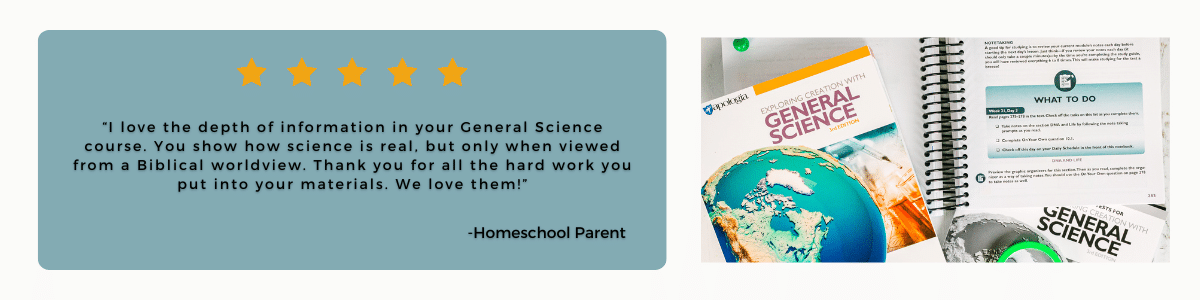
 Exploring Creation with General Science helps prepare your student as he or she approaches the more rigorous high school science courses by introducing key concepts early on.
📖 Apologia’s Exploring Creation with General Science, 3rd Edition, equips middle school students with the tools they need to easily transition from elementary to middle school level sciences. This is a true General Science course covering astronomy, meteorology, oceanography, earth study, geology, paleontology, and environmental science.
Mathematics
 Many students flourish in mathematics, while others need more practice. And that’s okay! That is one of the many benefits of homeschooling- having the ability to slow down and solidify concepts before moving on to harder ones. If you’re unsure whether your student is ready to jump into Pre-Algebra, this is the perfect course to solidify those foundational concepts and begin introducing new ones without being overwhelming.
📖 Apologia’s Live Class: Fundamentals of Math, a pre-recorded class led by Katie Pennington, B.S. in Natural Sciences and Mathematics, helps lay the foundation for students to excel in pre-algebra and provides a smooth transition to high school math.
Literature
Literature has always been a powerful way for authors to tell stories with deep and sometimes underlying messages. These themes include concepts such as good vs. evil, coming-of-age stories, and faith.
Apologia’s Self-Paced Literature Unit Study allows students to begin analyzing novels for those meanings. In this four-part unit study, students will read four Lamplighter Ministry novels and discover the major Christian themes within them. Each unit study is an individual course, and as a Self-Paced course, it can be completed at your student’s pace. Four unit studies are the equivalent of one full course credit.
 📖 Self-Paced The Basket of Flowers
James, the king’s gardener, teaches his 15-year-old daughter, Mary, all the principles of godliness through his flowers. She is falsely accused of stealing, and the penalty is death. Mary remembers what her father had taught her: that it is better to die for the truth than to live for a lie.
Major themes of this novel include honesty, purity, and courage.
 📖 Self-Paced A Peep Behind the Scenes
As an actress, Rosalie’s life seems perfect from the outside looking in. However, she is lost and in need of saving, especially when the only one she loves is taken from her. It is through her pain that she comes to realize the Good Shepherd has been seeking her and loving her all along.
The love of the Good Shepherd is the major theme of this novel.
📖 Self-Paced The Light in the Robber’s Cave
Horace is a rebellious young man who cares only for himself. However, things change quickly for Horace as he is taken against his will into the robbers’ cave. God brings some interesting people into his life, who help him discover light in the darkness.
Major themes of this novel include evangelism and shining as lights in the darkness.
📖 Self-Paced The Giant Killer
When ten-year-old twins, Adolphus and Constantine, are sent away to live with the family of their private tutor, they must adapt to life where fun seems to be in short supply.
Major themes of this novel include fighting against temptation and conquering your giants.
Choosing the right homeschool curriculum for 7th grade is about more than checking off subjects on a list. It’s an opportunity to help your student strengthen essential academic skills, grow in confidence, develop independent learning habits, and deepen their understanding of the world through a biblical worldview.
You don’t have to plan every detail perfectly from the beginning. Start with your family’s goals, choose resources that fit your student, and make adjustments along the way. With thoughtful planning and consistent encouragement, you can make seventh grade a rewarding year of academic growth and spiritual development.
Apologia’s suggested 7th-grade curriculum path offers resources in science, mathematics, worldview, and literature to help families build a meaningful year of learning. From exploring God’s creation in general science to strengthening math foundations and examining Christian themes in literature, these resources can help prepare students for the challenges and opportunities of high school.